
Understanding Margin in Forex Trading for South Africans
Learn how margin works in forex trading 🇿🇦. Understand leverage, risks, and smart margin management to trade safely and confidently in South Africa 💹.
Edited By
Emma Collins
Forex trading graphs are the backbone of currency trading. For those in South Africa looking to trade forex, understanding these charts isn’t just a nice-to-have — it’s essential. These graphs show the price movements of currency pairs like the US Dollar to South African Rand (USD/ZAR), helping you spot trends and make informed calls on when to buy or sell.
There are several types of charts you'll come across:

Line charts which connect closing prices over a selected time frame, giving a simple overview of market direction.
Bar charts that provide more detail, including the high, low, opening, and closing prices for each period.
Candlestick charts, popular among traders, illustrate price action visually with colour-coded bars that highlight bullish or bearish moves.
Each chart type serves a purpose. For example, candlesticks offer a snapshot of market sentiment within the trading session, useful for spotting reversals or patterns. Understanding these lets you read the market like a map.
Using technical indicators adds even more depth. Tools like Moving Averages, the Relative Strength Index (RSI), and Bollinger Bands help identify momentum, overbought or oversold conditions, and potential breakout points. For South African traders, riding these signals alongside local market news—such as SARB’s interest rate changes or shifts in USD/ZAR exchange rates—can be the difference between a smart trade and a costly mistake.
Mastering the basics of forex charts means you’re not just guessing — you’re trading based on data, context, and tested strategies.
Integrating this knowledge with an awareness of local factors like loadshedding risks or economic announcements prepares you better. So, whether you’re watching the rand against the euro or trading more exotic pairs, grasping forex charts will give you a solid foundation.
In the next sections, we’ll unpack how to read these charts in detail, explore key technical indicators, and share tips to tailor your strategy for South Africa’s unique market conditions.
Understanding the different types of forex trading graphs is key to making informed decisions. These graphs offer traders a visual way to track currency price movements and patterns, which helps in spotting trends and planning entries or exits. For South African traders, who often deal with pairs like ZAR/USD or ZAR/EUR, recognizing graph types lets you adapt to both global market swings and local influences such as political events or Eskom loadshedding impacts.
Line charts focus solely on closing prices for each time period, connecting these points with a continuous line. This keeps things straightforward and is especially handy when you want a quick view of how a currency pair has moved over hours, days, or weeks without the noise of intraday fluctuations.
These charts are most helpful for spotting broad trends or confirming the direction in which a market is moving. For example, if the line chart for ZAR/USD steadily climbs over several days, it suggests a strengthening rand. They’re also useful when you want to filter out the distractions of small price spikes.
That said, line charts do have their limits. They only show closing prices and ignore intraday highs and lows, which can tell you a lot about volatility and market sentiment. For active traders who want a fuller picture, line charts might leave out useful details.
Bar charts provide more information by showing the open, high, low, and close (OHLC) prices for each period. The vertical bar indicates the full price range, with small horizontal ticks showing where the price opened and closed.
This lets traders see how volatile a currency was within that timeframe. For instance, a tall bar with a large difference between the high and low on a rand pair means there was significant price movement, possibly driven by news or economic data.
Compared to line charts, bar charts give a fuller view but can be less intuitive than candlesticks. While candlestick charts focus on visual weight and colour to signal sentiment, bar charts are more straightforward and technical, preferred by traders who like precise OHLC info without the visual emphasis.
Candlestick charts combine price detail with visual clues about market mood. Each candle has a body representing the open-to-close range and wicks showing the highs and lows.
Candles come in different colours, usually green or white for a price increase and red or black for a decrease, making patterns easy to spot. Patterns like doji, hammers, or engulfing candles can indicate reversals or continuations, giving traders clues about potential moves.
These charts help traders make better decisions by showing not just what happened but how — was the market confident, hesitant, or volatile? For South African traders juggling volatile pairs like ZAR/USD during uncertain periods, candlestick charts provide a useful visual snapshot that supports timely strategy adjustments.
Forex trading graphs each tell a different story. Line charts offer simplicity, bar charts bring detail, and candlesticks reveal market psychology. Knowing when and how to use each can make all the difference, especially when South Africa's unique market factors come into play.
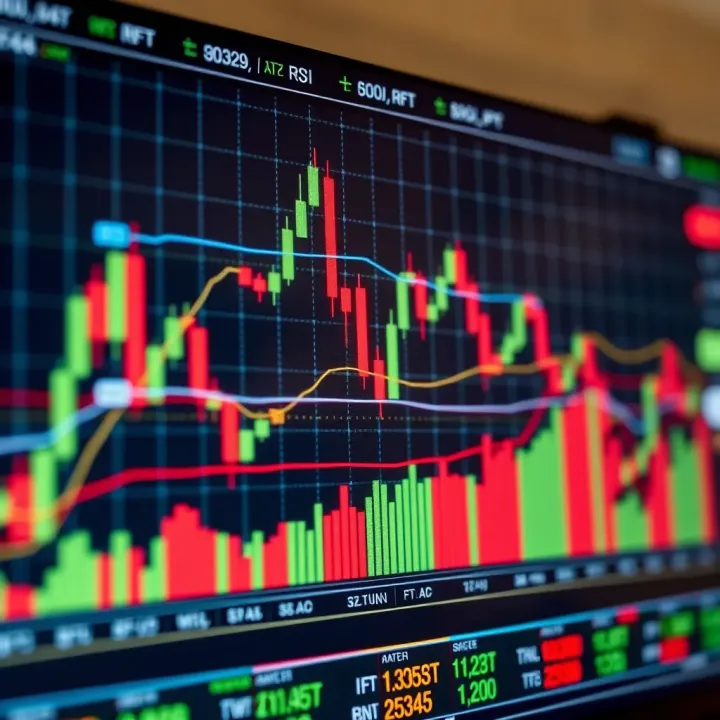
Interpreting forex graphs correctly is key to making smarter trading decisions. These charts offer a window into how currencies move, revealing patterns and points where the market might turn. For South African traders dealing with rand pairs, reading these signs can be the difference between a profitable trade and a costly mistake.
Recognising whether a currency pair is trending up, down, or moving sideways helps traders decide their next move. An upward trend means the price generally rises over time, while a downward trend shows consistent decline. Sideways trends indicate price consolidation, often signalling a pause before a big move. Spotting these trends early means you can jump on opportunities or avoid being caught on the wrong side of the market.
Drawing and using trendlines is a practical way to visualise these trends. By connecting a series of price lows in an uptrend or highs in a downtrend with a straight line, you create a guide for support or resistance. These lines help predict where price might bounce or break through. For example, if the ZAR/USD pair maintains higher lows and you draw a trendline underneath, a dip toward this line could be a buying opportunity.
Taking local context into account is crucial. The South African rand often reacts strongly to domestic political news, Eskom’s loadshedding schedules, or shifts in commodity prices. For instance, a sudden rand weakening after a negative Budget speech might break a trendline, warning traders about possible further declines.
Support and resistance levels act like invisible walls on forex charts. Support is where price tends to stop falling and may bounce back up, while resistance is where price struggles to move higher and might drop. You spot these levels by looking for repeated touches at certain price points without breaking through.
Understanding these levels helps in planning when to enter or exit trades. Buying near support can reduce risk, as the price might rebound from there; conversely, selling near resistance can lock in profits before a likely reversal. For example, if the USD/ZAR struggles to push past R18.50 repeatedly, that’s a resistance level traders watch closely.
Local market volatility means these levels can shift quickly. The rand is known for sudden moves when unexpected news breaks, such as a ratings downgrade or delayed infrastructure projects. Traders need to adjust their support and resistance assumptions accordingly, perhaps opting for wider stops or quicker profit-taking to manage these shifts safely.
Successful forex trading doesn’t just rely on spotting trends or levels but knowing how to apply these tools realistically in South Africa's unique market environment.
By honing skills in reading trends, trendlines, and support/resistance, South African traders stand a better chance of navigating rand volatility and making decisions that improve their trading outcomes.
Technical indicators help traders make sense of the often chaotic movement on forex charts. They offer clues on momentum, trend strength, and potential reversals, which can be invaluable when trading rand currency pairs. In turn, using these indicators alongside charts sharpens your decision-making, reducing guesswork and improving timing.
Moving averages smooth out price data to highlight underlying trends. The simple moving average (SMA) calculates the average price over a set number of periods, treating each price equally. Meanwhile, the exponential moving average (EMA) gives more weight to recent prices, making it more responsive to current market moves. For South African traders, this distinction matters because rand pairs can react sharply to local news or data releases, where a lagging SMA might delay signals.
Integrating moving averages with chart patterns can confirm trend direction or signal potential changes. For example, when a short-term moving average crosses above a longer one—a so-called "golden cross"—it often points to a bullish trend. Conversely, a "death cross" warns of a possible downturn. Watching these crossovers alongside support and resistance areas on the chart helps fine-tune entries and exits.
Take the USD/ZAR pair as an example: traders often monitor the 20-day EMA crossing the 50-day SMA on four-hour charts. Such moves can precede sharp rand volatility, especially around key local events like Reserve Bank rate announcements.
The RSI measures the speed and change of price movements, signalling overbought or oversold conditions. Values above 70 typically imply an asset is overbought and may dip, while readings below 30 indicate oversold conditions possibly ripe for a bounce. For rand pairs, which can swing abruptly, the RSI aids in spotting when a reversal might be imminent before it's obvious.
Oscillators like the Stochastic or MACD complement RSI by confirming trend strength or warning of reversals. When multiple oscillators align on a signal, it adds conviction to trade decisions.
South African trading hours, particularly overlapping global sessions with London or New York, often show distinctive RSI and oscillator behaviours. The rand tends to react sharply at market opens and closes, so monitoring these indicators in those time windows can improve entry timing.
Volume reflects how many units of a currency pair trade over a period and is a key gauge of market interest. High volume during price moves suggests conviction behind a trend, while low volume might warn of a false breakout.
Overlaying volume onto price charts spotlights whether moves are supported by real trading activity. For example, a USD/ZAR breakout above resistance accompanied by spiking volume is likelier to sustain than one on weak volume.
Locally, volume patterns can shift around South African market peculiarities such as public holidays or during load-shedding periods, when trading slows. Recognising these patterns helps avoid getting whipsawed by erratic volume spikes.
Combining these key technical indicators with your charts can add invaluable context to forex trading, especially when dealing with the rand’s unique market factors. It’s not just about spotting opportunities but confirming them reliably.
Forex trading charts aren't just pretty pictures; they need to be set up smartly to serve your strategy. Getting your charts right can sharpen your decisions and save you time, which is crucial when markets move as fast as they do, especially with rand pairs reacting to both local and global events.
The timeframe you pick depends on your trading style. If you're a day trader in Johannesburg, using 5-minute or 15-minute charts helps catch quick moves and scalp profits within a session. For a swing trader in Cape Town, 4-hour or daily charts provide a broader view to capture trends developing over days or weeks. Mixing timeframes—such as combining daily trends with hourly entries—can also give you a better edge.
Bright or clashing colours might look cool but can strain your eyes over a trading day. Many traders prefer softer palettes with contrasting colours; for example, green for rising candles and red for falling, against a dark or neutral background to reduce glare. South African traders working late into the evening, when loadshedding cuts daylight, find dimmer colour schemes easier on the eyes.
Once you customise your chart—selecting indicators, timeframes, colours, and drawings—save this setup as a template. This means next time you open your trading platform, your preferred layout loads instantly, letting you focus on the market instead of fiddling with settings. Platforms like MetaTrader or TradingView allow this feature, making it handy for the trader juggling rand/USD, rand/EUR, and rand/GBP pairs.
Depending solely on one indicator, like RSI or moving averages, can give a skewed view. For example, during periods of low liquidity in South African rand pairs—such as before public holidays—some signals may produce false results. Combining different indicators and chart types often helps confirm signals and improves accuracy.
It’s easy to see what you want on a chart, especially after a poor trade. If you’re convinced a currency will bounce back because you’re emotionally attached to a position, you might misread signals or ignore red flags. Keeping a trading journal and sticking to objective rules can help South African traders avoid this pitfall.
Power outages or sudden political developments can disrupt trading or spark volatile moves in the rand. For instance, unexpected loadshedding stages may lead to brief spikes in volatility. Being aware of these factors helps you avoid trading blindly and manage risk better during such unpredictable periods.
Economic reports—like SARB’s interest rate decisions or inflation figures—often cause jumps or drops in currency pairs. If a chart shows a support level and the SARB signals a rate pause, a bounce might follow. Aligning your technical analysis with these fundamental cues improves timing and trade confidence.
As a relatively small but resource-rich economy, South Africa’s rand is sensitive to global market shifts, commodity prices, and US dollar moves. Watching how the rand behaves against commodities or USD charts alongside your forex graphs can reveal hidden risks or opportunities.
Neither technical charts nor fundamental news alone tell the full story. Combining both helps build a more reliable trading plan. For example, if your charts show a downtrend but upcoming SA economic policies threaten rand strength, you might hold off on short trades and wait for clearer signals.
Effective forex trading in South Africa means tailoring both your charts and analysis to local market rhythms, practical challenges, and currency behaviour. With thoughtful preparation and awareness, your charts become not just tools, but valuable guides in navigating the forex markets.
Learn how margin works in forex trading 🇿🇦. Understand leverage, risks, and smart margin management to trade safely and confidently in South Africa 💹.
🌍 Discover how to trade forex in South Africa without upfront costs. Learn about free platforms, local rules, and practical tips for beginners. 💹
📈 Explore forex trading sessions from a South African viewpoint, learning how global market hours and overlap impact your strategies for better results.

Discover practical forex trading tips for South African traders 🇿🇦, including strategies, risk control, market analysis, and mindset for better results 📈💡.
Based on 7 reviews